
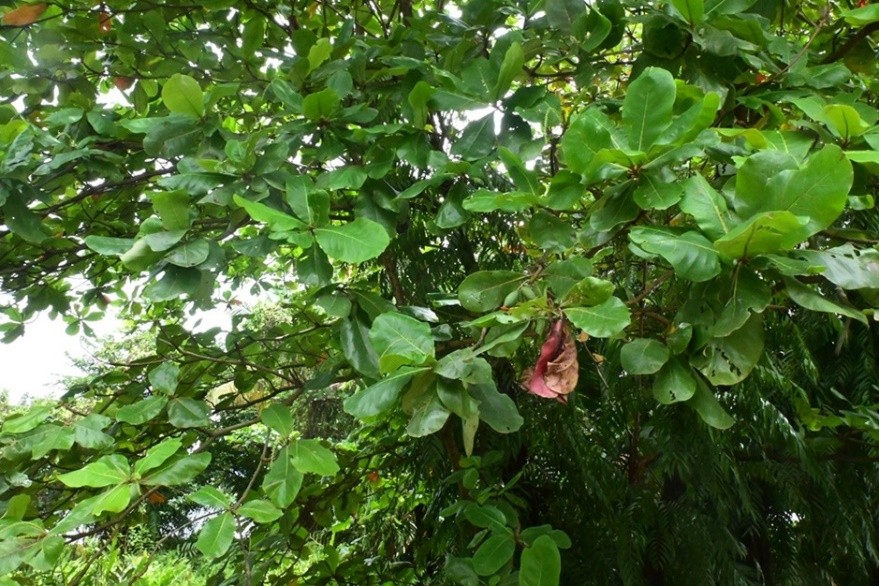
Terminalia catappa L.
Campus Location
Rajagiri Business School, Valley Campus, Kakkanad
Systematic position
Kingdom: Plantae
Phylum: Streptophyta
Class: Equisetopsida
Order: Myrtales
Family: Combretaceae
The native range of Indian Almond is Comoros, Madagascar, Tropical & Subtropical Asia to Pacific, North Australia. The tree grows primarily in the wet tropical biome. to 35 metres tall, with an upright, symmetrical crown and horizontal branches. Large and ovoid leaves with 15–25 cm length and 10–14 cm breadth with a glossy and leathery dark green surface. It is a monoecious species with distinct small male and female flowers on the same tree, produced on axillary or terminal spikes, white to greenish colour, inconspicuous with no petals. The fruit is a drupe, containing a single seed.
- The plant is an ornamental tree, used as medicine and food.
- It is used to treat unspecified medicinal disorders, and also has environmental uses and social uses.
- The tree is used as animal food, and a medicine and for fuel and food.
Terminalia catappa L.
Campus Location
Rajagiri Business School, Valley Campus, Kakkanad
Systematic position
Kingdom: Plantae
Phylum: Streptophyta
Class: Equisetopsida
Order: Myrtales
Family: Combretaceae
The native range of Indian Almond is Comoros, Madagascar, Tropical & Subtropical Asia to Pacific, North Australia. The tree grows primarily in the wet tropical biome. to 35 metres tall, with an upright, symmetrical crown and horizontal branches. Large and ovoid leaves with 15–25 cm length and 10–14 cm breadth with a glossy and leathery dark green surface. It is a monoecious species with distinct small male and female flowers on the same tree, produced on axillary or terminal spikes, white to greenish colour, inconspicuous with no petals. The fruit is a drupe, containing a single seed.
- The plant is an ornamental tree, used as medicine and food.
- It is used to treat unspecified medicinal disorders, and also has environmental uses and social uses.
- The tree is used as animal food, and a medicine and for fuel and food.