
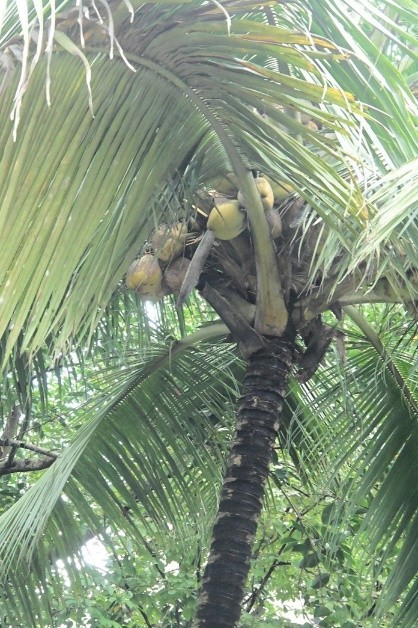
Cocos nucifera (L.)
Campus Location
Rajagiri Business School, Valley Campus, Kakkanad
Systematic position
Kingdom: Plantae
Phylum: Streptophyta
Class: Equisetopsida
Order: Arecales
Family: Arecaceae
Coconut tree is originally native to the Central Indo-Pacific, ubiquitous in coastal tropical regions. It is a large palm, monoecious, grow up to 30 metres tall with pinnate leaves. The coconut fruit is a drupe containing three layers: the exocarp, mesocarp, and endocarp. The mesocarp is composed fibrous coir, which has many traditional and commercial uses. The exocarp and the mesocarp make up the "husk" of the coconut, while the endocarp makes up the hard coconut "shell", initially filled with a liquid endosperm.
- The coconut tree provides food, fuel, cosmetics, folk medicine and building materials.
- The inner flesh of the mature fruit forms a regular part of the diets of many people in the tropics and subtropics.
- Coconut endosperm contains a large quantity coconut water.
- Mature coconuts are processed for oil and coconut milk from the flesh, charcoal from the hard shell, and coir from the fibrous husk.
- Dried coconut is called copra, the source of oil and milk, which are commonly used in cooking and in soaps and cosmetics.
- Sweet coconut sap can be made into drinks or fermented into palm wine or coconut vinegar.
- The hard shells, fibrous husks and long pinnate leaves are used to make products for furnishing, decoration and handicrafts.
Cocos nucifera (L.)
Campus Location
Rajagiri Business School, Valley Campus, Kakkanad
Systematic position
Kingdom: Plantae
Phylum: Streptophyta
Class: Equisetopsida
Order: Arecales
Family: Arecaceae
Coconut tree is originally native to the Central Indo-Pacific, ubiquitous in coastal tropical regions. It is a large palm, monoecious, grow up to 30 metres tall with pinnate leaves. The coconut fruit is a drupe containing three layers: the exocarp, mesocarp, and endocarp. The mesocarp is composed fibrous coir, which has many traditional and commercial uses. The exocarp and the mesocarp make up the "husk" of the coconut, while the endocarp makes up the hard coconut "shell", initially filled with a liquid endosperm.
- The coconut tree provides food, fuel, cosmetics, folk medicine and building materials.
- The inner flesh of the mature fruit forms a regular part of the diets of many people in the tropics and subtropics.
- Coconut endosperm contains a large quantity coconut water.
- Mature coconuts are processed for oil and coconut milk from the flesh, charcoal from the hard shell, and coir from the fibrous husk.
- Dried coconut is called copra, the source of oil and milk, which are commonly used in cooking and in soaps and cosmetics.
- Sweet coconut sap can be made into drinks or fermented into palm wine or coconut vinegar.
- The hard shells, fibrous husks and long pinnate leaves are used to make products for furnishing, decoration and handicrafts.